
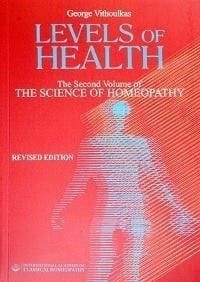
Levels of Health: The Second Volume of “The Science of Homeopathy” by GEORGE VITHOULKAS [#VITLEV]
$ 32.40
Description Levels of Health -The Second Volume of “The Science of Homeopathy” REVISED EDITION By George Vithoulkas Professor George Vithoulkas briefly mentions the premise of “The Levels of Health” in his main textbook, “The Science of Homeopathy”, published in 1977. After 57 years of experience and diligent observation in homeopathic practice, he presents the fully developed practical theory for application in everyday practice. “Levels of Health” is a highly original contribution to homeopathy and the medical field as a whole. Vithoulkas explains his concept of the twelve levels of health in detail, meticulously elaborating on the indications to which level a patient belongs. He delineates the possible reactions of the organism’s defense mechanism to homeopathic treatment – as well as what the reactions indicate. This volume provides formulas for the physician to recognize whether a patient is improving after the prescribed remedy, as well as the prognosis. It also gives invaluable advice to the practitioner for assessing the gravity and severity of cases. Levels of Health is the new pioneering theory: a vital component in homeopathic prescribing that all practitioners of homeopathy should embrace. TABLE OF CONTENTS PREFACE Introduction: The Practice of Homeopathy The Energy Complex of the Organism: Hahnemann’s “Vital Force” The Defense Mechanism and the Energy Complex Symptoms are Beneficial The Consequences of Suppressing Symptoms Evaluation of Prescription The Direction of Cure Chapter 1: General Description of the Levels of Health Fluctuation of the Organism within the Same Level Chapter 2: Prognosis and Life Expectancy Chapter 3: Genetic Predisposition to Life Expectancy Chapter 4: Implications of Susceptibility Natural Defense versus Bacterial Eradication Acute Illnesses Belong to Healthier Organisms Absence of Fever = Lack of Vitality Chapter 5: Genetic Predisposition: Hahnemann’s Miasms Predisposition in Relation to Levels of Health Science of Sequential Remedies Required for Greater Predisposition Chapter 6: The Definition and Importance of a Clear Remedy Pattern Chapter 7: Potency Selection Repetition of Doses Indications for Potencies within Various Levels Chapter 8: Antidotes to Homeopathic Treatment 1. Pharmaceuticals and Vaccinations 2. Recreational Drugs 3. Coffee 4. Severe Mental or Emotional Stresses 5. Dental Treatment 6. Wrong Repetition of Remedies 7. Other Therapeutic Modalities 8. Strong Odors 9. Antidotal Factors upon the Remedy Itself Chapter 9: Acute Diseases during Chronic Treatment Group A: Level One, Level Two and Level Three Group B: Level Four, Level Five and Level Six Group C: Level Seven, Level Eight and Level Nine Group D: Level Ten, Level Eleven and Level Twelve Chapter 10: The Management of Acute Conditions during the Treatment of a Chronic Condition Appearance of an Acute Disease within the First Three Days after Taking a Remedy Group A: Level One, Level Two, Level Three Group B: Level Four, Level Five, Level Six Group C: Level Seven, Level Eight, Level Nine Group D: Level Ten, Level Eleven, Level Twelve Appearance of an Acute Disease Seven to Fifteen Days after Taking the Remedy Group A: Level One, Level Two, Level Three Group B: Level Four, Level Five, Level Six Group C: Level Seven, Level Eight, Level Nine Group D: Level Ten, Level Eleven, Level Twelve Appearance of an Acute Disease One Month after Taking the Remedy Group A: Level One, Level Two, Level Three Group B: Level Four, Level Five, Level Six Group C: Level Seven, Level Eight, Level Nine Group D: Level Ten, Level Eleven, Level Twelve Appearance of an Acute Disease Six Months after Taking the Remedy Group A: Level One, Level Two, Level Three Group B: Level Four, Level Five, Level Six Group C: Level Seven, Level Eight, Level Nine Group D: Level Ten, Level Eleven, Level Twelve Chapter 11: General Conclusions Concerning Acute Diseases during Chronic Treatment Clarification: Rules Are Not without Exceptions Chapter 12: Remedy Reactions Formulating the Homeopathic Prognosis of a Case Parameters that Enable a Homeopath to Make a Three-Dimensional Evaluation of a Case Chapter 13: Observations of Remedy Reactions and Posology Considerations Observation 1 Clear initial aggravation of the main physical complaint(s), the mental/ emotional symptoms and the energy level— followed by a quick, longlasting recovery Observation 2 The patient feels much better in every aspect, but there is little or no aggravation Observation 3 After an initial aggravation, the patient feels much better in every aspect, but some symptoms remain Observation 4 After an initial aggravation there is local and general amelioration, but new symptoms appear belonging to the remedy given Observation 5 The physical symptoms subside after an initial aggravation, but there has been no reaction on the mental– emotional plane or the energy level Observation 6 No initial aggravation: the patient reports being better but is not really well Observation 7 The patient’s main complaint has ameliorated without aggravation, but a new problem now emerges Observation 8 The patient’s original complaint is somewhat better, but new symptoms dominate the case, completing the remedy pattern Observation 9 Short aggravation followed by local and general amelioration, then partial relapse after one month Observation 10 Actual relapse one month after a positive reaction Observation 11 Temporary amelioration without initial aggravation, then a full relapse after one month Observation 12 Amelioration in certain areas without aggravation, but after some weeks the patient is worse than before (with or without a change of symptoms) Observation 13 No change in the case Observation 14 A reserved or shy patient who reports that nothing has changed Observation 15 Improvement of some minor physical symptom without any further changes in a reserved or intellectual patient Observation 16 Improvement of a minor physical symptom without any other changes in an extroverted patient Observation 17 The patient reports a deterioration, but there may have been some improvement in the past few days Observation 18 Steady aggravation of all symptoms Observation 19 Clear, long-lasting aggravation, followed by improvement for four to five days, then by continued deterioration Observation 20 The patient has been feeling worse for an entire month Observation 21 Over the course of the month, the chief complaint has become more severe, while other symptoms have improved Observation 22 The mental–emotional plane deteriorates, while the energy level and physical complaints are improved after an aggravation Chapter 14: Summary of the Levels of Health Summary of Group A Summary of Group B Summary of Group C Summary of Group Paperback, 170 pages ISBN: 978-618-83312-04


Related products
-
 Bakery van Vessem – HaarlemSelect options
This product has multiple variants. The options may be chosen on the product page
Bakery van Vessem – HaarlemSelect options
This product has multiple variants. The options may be chosen on the product page
-
 Interior office Strijp-TSelect options
This product has multiple variants. The options may be chosen on the product page
Interior office Strijp-TSelect options
This product has multiple variants. The options may be chosen on the product page
-
 Artist’s studio for Marc MuldersSelect options
This product has multiple variants. The options may be chosen on the product page
Artist’s studio for Marc MuldersSelect options
This product has multiple variants. The options may be chosen on the product page